Local Flyer Marketing: How to Plan a Campaign That Works
Local flyer marketing can give businesses a practical way to put an offer, service or event directly in front of a defined local audience. But printing a large number of flyers is only one part of a campaign. The audience, message, distribution area, call to action and measurement plan all need to work together.
A successful local flyer campaign starts before the artwork is sent to print. You need to know who you want to reach, what you want them to do and how you will measure the response.
This guide explains how to plan a local flyer marketing campaign from the initial audience research through to printing, distribution and measurement.
What Is Local Flyer Marketing?
Local flyer marketing is the use of printed flyers to promote a business, product, service, offer or event to a defined local audience.
The campaign may involve distributing flyers door to door, handing them to people, placing them in suitable locations or using other distribution methods. The right approach depends on the audience and the purpose of the campaign.
Government campaign guidance recommends thinking carefully about who the campaign is intended to reach, where people will see the material and what action you want them to take.
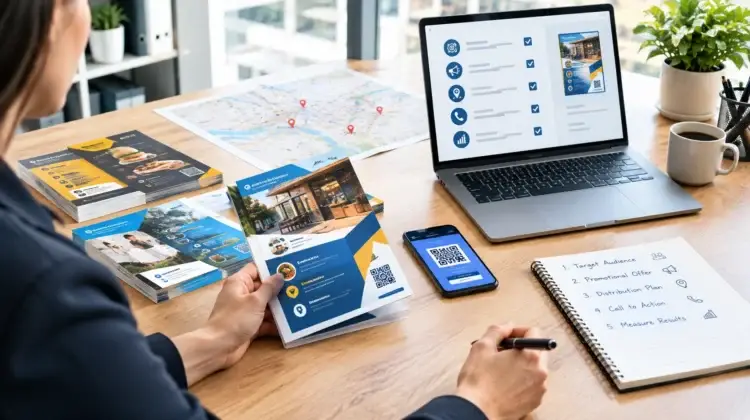
For a local business, this means your campaign should answer five basic questions:
- Who are we trying to reach?
- What are we offering?
- Where will the flyers be distributed?
- What should the reader do next?
- How will we measure the response?
Step 1: Define Your Target Audience
The first step in local flyer marketing is identifying your audience.
Avoid treating everyone in a town or city as one audience. Think about the people most likely to need your product or service.
For example, a local business might target:
- Homeowners in selected areas
- People within a particular service area
- Local families
- Students
- Businesses in a commercial district
- Customers interested in a particular service
- Visitors attending a local event
Your audience should influence the wording, offer, design and distribution area.
Think about where your potential customers live, work or spend time. Government campaign guidance also recommends considering where materials will be seen, expected footfall and whether the audience has time to read or take away the material.
Ask These Audience Questions
Before designing your flyer, ask:
- Who is most likely to buy from us?
- Which areas contain these customers?
- What problem are we helping them solve?
- What information do they need before contacting us?
- Where are they most likely to encounter our flyer?
The clearer your audience is, the easier it becomes to create a relevant campaign.
Step 2: Create One Clear Offer
Your flyer should give people a reason to pay attention.
That might be:
- A specific service
- A new business opening
- A seasonal promotion
- An event
- A new product
- A local service area
- A booking opportunity
- A clearly explained customer benefit
Avoid trying to promote every product or service your business offers on one flyer.
A flyer has limited space, so prioritise the message that matters most to the campaign.
For example, instead of making the headline a general statement about your company, make the main message about the specific service or offer you want the audience to notice.
The reader should understand the main point quickly.
Step 3: Build a Simple Flyer Structure
A useful flyer structure can be straightforward:
Headline
Tell the reader what the flyer is about.
Main Offer or Benefit
Explain why the reader should be interested.
Supporting Information
Give enough detail to help the reader understand the service or offer.
Trust and Contact Information
Include relevant business information and contact details.
Call to Action
Tell the reader exactly what to do next.
Do not make the reader search through the flyer to find the next step.
The UK Government Campaign Resource Centre recommends keeping calls to action such as website addresses, phone numbers or email addresses short and clear.
Step 4: Choose the Distribution Area
Once you know your audience and message, decide where the flyers should go.
The distribution area should make commercial sense for your business.
For a local service business, this could mean focusing on areas within its normal service range. For a shop, restaurant or local event, the relevant area may depend on where customers are likely to travel from.
Consider:
- Postcodes or neighbourhoods
- Distance from your business
- Customer demographics
- Existing customer locations
- Footfall
- Local events
- Residential versus commercial areas
- Timing of the campaign
Do not automatically assume that distributing more flyers across a wider area is better. A smaller, relevant audience can make the campaign easier to manage and measure.
Step 5: Match Printing to the Campaign
Once the campaign strategy is clear, prepare the printed flyers.
Think about:
- Flyer size
- Quantity
- Single- or double-sided design
- Paper requirements
- Colour and branding
- Artwork quality
- Contact information
- Call to action
Your printed material should support the campaign rather than become the campaign itself.
For businesses planning a flyer campaign, iFix Prints provides flyer printing options that can be used for local promotions, services, events and other marketing activity.
You can link this article naturally to your Flyers service page:
You can also link to the Standard Flyers page where appropriate:
Step 6: Use a Specific Call to Action
A call to action, or CTA, tells the reader what to do next.
Examples include:
- Visit our website
- Call us today
- Request a quote
- Book an appointment
- Scan the QR code
- Visit our local shop
- Use the offer code
- Contact us for more information
Choose one primary action.
If your flyer contains five different instructions, the reader may not know which one matters most.
The CTA should also connect directly with your campaign objective.
For example:
Goal: Generate enquiries
CTA: Call for a quote
Goal: Drive website visits
CTA: Visit the campaign landing page
Goal: Promote an offer
CTA: Use the printed offer code
Step 7: Make Your Flyer Campaign Measurable
One of the biggest challenges with printed marketing is knowing what happened after distribution.
The solution is to plan measurement before the flyers are printed.
Possible tracking methods include:
- A dedicated landing page
- A unique website URL
- A QR code
- A unique promotional code
- A dedicated telephone number
- A phone extension
- A customer enquiry question
- A simple response form
The UK Government Campaign Resource Centre specifically recommends using unique phone numbers, landing pages, CTAs, coupons, QR codes and customer feedback to help measure leaflet and poster campaigns.
Example
Suppose your flyer says:
“Visit our website and use code LOCAL10.”
You can then record how many customers use that code.
Or you could use a dedicated campaign landing page so website visits and enquiries can be associated with the printed campaign.
This gives you more useful information than simply knowing how many flyers were printed.
Step 8: Compare the Results
After distribution, collect the campaign data.
Useful questions include:
- How many flyers were distributed?
- Which areas were covered?
- How many enquiries were received?
- How many website visits came from the campaign?
- How many QR code scans occurred?
- How many offer codes were used?
- How many enquiries became customers?
- Which distribution area generated the most responses?
- What was the cost of the campaign?
- What revenue or business outcome can be attributed to it?
Campaign KPIs should be defined before the campaign starts so the results can be evaluated against a clear objective.
Local Flyer Marketing Checklist
Before launching your campaign, use this checklist:
Audience
- Target audience clearly defined
- Relevant local area selected
- Customer need identified
Offer
- One main campaign objective
- Clear offer or message
- Important information easy to find
Design
- Strong headline
- Clear supporting information
- Correct contact details
- Consistent branding
- Clear CTA
- Artwork proofread
Distribution
- Distribution area selected
- Quantity planned
- Timing considered
- Distribution method selected
Measurement
- Tracking method created
- QR code or landing page tested
- Offer code prepared if required
- Enquiries will be recorded
- Campaign results will be reviewed
Frequently Asked Questions
Does flyer marketing work for local businesses?
Flyer marketing can be used as part of a local business campaign when the audience, message, distribution and CTA are planned together. Its effectiveness depends on factors such as the target audience, offer, distribution method, timing and how responses are measured. Tracking the campaign gives you evidence to assess its performance.
How do I create a local flyer marketing campaign?
Start by defining your target audience and campaign objective. Then create one clear offer, design the flyer around that message, select a relevant distribution area, choose a clear call to action and add a tracking method such as a QR code, dedicated landing page or promotional code.
Where should I distribute business flyers?
Choose locations where your target customers are likely to live, work or spend time. For local businesses, this may involve selected residential areas, commercial locations or other suitable places. The appropriate distribution area depends on your customer base and campaign objective.
What should I put on a business flyer?
A business flyer should normally communicate the main offer or message, explain the relevant benefit, provide useful supporting information, show appropriate contact details and include a clear call to action. Avoid overcrowding the flyer with information that does not support the campaign objective.
How can I measure flyer marketing results?
Use a method that connects responses to the campaign. Options include a unique promotional code, dedicated landing page, QR code, telephone number, phone extension or asking customers how they heard about the business. Government campaign guidance recommends planning measurement methods such as these before evaluating the campaign.
How many flyers should a local business print?
There is no single quantity that suits every campaign. The required quantity depends on the target area, audience, distribution method and campaign objective. Estimate the number of people or locations you want to reach and align the print quantity with the planned distribution.
Do I need permission to distribute flyers in the UK?
Rules can depend on where and how flyers are distributed. In England and Wales, GOV.UK states that permission may be required for distributing free printed material in certain areas controlled by local councils. Businesses should check the relevant local council requirements before distributing flyers in public areas.
Conclusion
Local flyer marketing works best when it is treated as a complete campaign rather than simply a printing exercise.
Start with the audience. Decide what you want to promote and give people one clear reason to respond. Choose a distribution area that matches your customers, create a straightforward CTA and build measurement into the flyer before it is printed.
After distribution, review the responses and compare them with the campaign objective. This makes it easier to understand what happened and improve future campaigns.
For businesses that need professionally printed promotional materials, explore the iFix Prints Flyers service and choose the flyer format that suits your campaign.