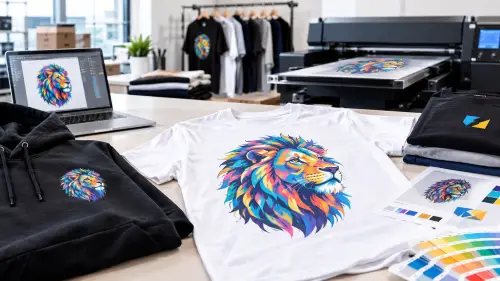
DTF Printing for Businesses: What You Should Know
Businesses have many reasons to print clothing, from branded workwear and promotional clothing to event merchandise and custom apparel. One option available for these projects is DTF printing for businesses, a clothing-printing method designed to transfer detailed, full-colour artwork onto garments.
But is DTF the right choice for every clothing project? Not necessarily. The most suitable printing method depends on the artwork, garment, quantity, placement and the appearance you want to achieve.
This guide explains DTF printing in straightforward terms and compares it at a high level with other clothing printing options available from iFix Prints.
What Is DTF Printing?
DTF printing, or Direct-to-Film printing, is a garment-decoration process in which artwork is digitally printed onto a transfer film and then transferred onto clothing using heat.
At iFix Prints, DTF printing is presented as a full-colour clothing-printing option suitable for detailed artwork, multi-colour designs, cotton and polyester fabrics, custom clothing, promotional wear, and both small and bulk orders.
The important point for businesses is that DTF can provide flexibility when a design contains multiple colours, gradients, shading or detailed artwork.
Why Consider DTF Printing for Business Clothing?
Business clothing often needs to combine branding with practical garment use. A company may want its logo on staff clothing, promotional garments for an event or custom apparel featuring a detailed design.
iFix Prints lists several characteristics of its DTF service, including full-colour printing, support for complex and multi-colour artwork, different garment colours, multiple print placements and design support.
1. Detailed and Multi-Colour Artwork
DTF can be useful when your artwork contains more than a simple logo or block of colour.
The iFix Prints DTF page specifically states that its service supports gradients, shading and complex artwork.
This can make it worth considering for:
- Detailed brand artwork
- Multi-colour graphics
- Promotional designs
- Illustrations
- Photographic-style artwork
- Designs containing gradients or shading
The artwork itself should still be prepared correctly for printing, and the final result depends on the supplied design and garment.
2. Different Garment Colours
iFix Prints states that its DTF printing is suitable for both light and dark garments and describes the service as compatible with a range of fabric colours.
This can be useful for businesses that want to maintain consistent branding across different clothing colours.
3. Multiple Print Placements
Business clothing does not always need a logo in one standard position.
The iFix Prints DTF page lists front, back, pocket and sleeve placements.
For example, a business might use:
- A small logo on the chest
- Larger branding on the back
- A design on a sleeve
- A pocket-area logo
The appropriate placement depends on the garment and the intended appearance.
DTF Printing vs Other Clothing Printing Methods
There is no single printing method that is automatically suitable for every business clothing project.
iFix Prints’ hoodie service lists DTF, HTV, embroidery and screen printing among its available print types.
The practical differences can be considered at a high level:
| Method | General characteristics | Consider when |
|---|---|---|
| DTF | Full-colour transfer suitable for detailed artwork | Your design contains multiple colours, gradients or detail |
| HTV | Heat-applied vinyl with a clean, defined appearance | You need names, numbers, logos or simpler graphics |
| Embroidery | Stitched decoration rather than a printed surface | A stitched branding effect suits the garment |
| Screen Print | Traditional print method listed by iFix Prints | Your project is suited to a screen-printing workflow |
This table is a practical comparison rather than a statement that one method is universally better.
DTF vs HTV
HTV, or Heat Transfer Vinyl, uses heat-applied vinyl to create a design on a garment.
iFix Prints describes HTV as suitable for simple graphics, names, numbers, logos, sportswear, team uniforms and personalised apparel. Its HTV page also lists multiple vinyl types and colours.
DTF may therefore be worth considering when your artwork is more detailed or contains gradients and multiple colours, while HTV can be appropriate for simpler text, names, numbers and logo designs.
DTF vs Embroidery
Embroidery creates a stitched design rather than a printed image.
This creates a fundamentally different appearance from DTF. If your business wants a traditional embroidered logo on clothing, embroidery may be worth considering. If the artwork relies on detailed colour reproduction, a printed method such as DTF may be more relevant.
The right choice depends on the artwork, garment and visual style required.
DTF vs Screen Printing
Screen printing is another clothing-decoration method listed by iFix Prints for its hoodie service.
Rather than assuming one method is always better, businesses should consider the artwork, order requirements, garment and desired finish before selecting a production method.
For a project involving detailed full-colour artwork, DTF is one option to discuss with the printer.
When Is DTF Useful for Business Clothing?
DTF can be particularly relevant when a business needs clothing featuring detailed or colourful artwork.
Potential applications include:
- Staff and branded clothing
- Promotional wear
- Event clothing
- Custom T-shirts
- Custom hoodies
- Brand merchandise
- Small clothing orders
- Bulk clothing orders
iFix Prints specifically lists custom clothing, promotional wear and both small and bulk orders among its DTF applications.
The important consideration is to match the printing method to the actual project rather than choosing a process based only on the name of the technology.
What Should Businesses Check Before Ordering DTF Clothing?
Before placing an order, consider these factors.
Artwork
Check that your artwork is high enough quality for the intended print size. If the design contains gradients, shading or multiple colours, mention this when discussing the project.
iFix Prints also offers design support and describes its DTF service as supporting complex artwork.
Garment
Consider the garment type, colour and intended use. T-shirts and hoodies can have different requirements, so confirm that the chosen garment is suitable for the planned printing method.
Print Placement
Decide whether the design should appear on the front, back, sleeve or pocket area.
For branded business clothing, keeping the logo size and placement consistent across garments can help maintain a coherent visual identity.
Quantity
Decide whether you need one garment, a small batch or a larger order.
iFix Prints states that its DTF service accepts both single and bulk orders.
Proof or Mockup
Before production, review the artwork placement and appearance. iFix Prints’ DTF ordering process includes approving a digital mockup before printing and transfer begins.
This gives businesses an opportunity to check the design before production.
A Simple DTF Ordering Process
For a straightforward business clothing project, the process can be approached in five stages:
- Prepare your artwork
Have your logo, design or artwork ready. - Choose the garment
Select the clothing type, colour and required sizes. - Choose the placement
Decide whether the design goes on the front, back, sleeve or pocket. - Review the mockup
Check how the design will appear on the garment. - Approve production
Once the artwork and placement are approved, printing and transfer can begin.
This broadly follows the DTF ordering process published by iFix Prints.
Frequently Asked Questions
What is DTF printing?
DTF printing is a garment-decoration method that uses printed transfer film and heat to apply artwork to clothing. It is designed for full-colour designs and can be used for detailed artwork. iFix Prints lists DTF for custom clothing, promotional wear and both small and bulk orders.
When is DTF useful for business clothing?
DTF can be useful when business clothing requires detailed, colourful or multi-colour artwork. iFix Prints specifically lists detailed artwork, gradients, shading, custom clothing and promotional wear among its DTF applications.
Can DTF printing be used on dark clothing?
Yes. iFix Prints states that its DTF service is suitable for light and dark garments and describes it as suitable for different fabric colours. The exact garment should still be confirmed when ordering.
Is DTF suitable for detailed designs?
DTF can be suitable for detailed designs. iFix Prints states that its DTF service supports complex and multi-colour artwork, gradients, shading and high-detail output. This makes it an option worth considering when a business design contains more detail than a simple logo or text.
Is DTF available for small business orders?
Yes. iFix Prints states that its DTF service accepts both single pieces and bulk orders. This can make the method relevant to businesses with smaller clothing requirements as well as larger promotional or apparel projects.
Is DTF better than HTV for business clothing?
Neither method should automatically be considered better for every project. DTF is presented by iFix Prints for detailed, multi-colour artwork, while HTV is described as suitable for simple graphics, names, numbers, logos and personalised apparel. The artwork and garment requirements should determine the choice.
Can businesses use DTF for T-shirts and hoodies?
DTF is available as a clothing-printing option from iFix Prints, while its hoodie page specifically lists DTF alongside HTV, embroidery and screen printing. The DTF page also lists custom clothing and promotional wear as suitable applications.