How Loyalty Cards Can Support Local Business Marketing
Loyalty cards can help local businesses encourage repeat visits, reward regular customers and create a more consistent customer experience. For independent cafés, salons, restaurants, convenience shops and other small businesses, a simple printed loyalty card provides a physical reminder of the value customers receive when they return.
When supported by a clear reward structure and friendly customer service, printed loyalty cards can become a practical part of a wider local marketing strategy. The key is to make the offer easy to understand, affordable to deliver and simple to measure.
What Are Customer Loyalty Cards?
Customer loyalty cards are printed or digital cards that reward customers for repeat purchases, visits or eligible transactions. A typical printed card contains a series of spaces that a business stamps or marks whenever a customer makes a qualifying purchase.
After collecting the required number of stamps, the customer receives a clearly defined reward, such as a complimentary drink, a discount or a selected product.
For local businesses, loyalty cards offer a straightforward way to connect everyday transactions with a longer-term customer relationship.
How Loyalty Cards Support Local Business Marketing
1. Encourage Repeat Visits
One of the main purposes of a loyalty card is to give customers a reason to return. A clearly explained reward creates an incentive to choose the same local business again when they next need its products or services.
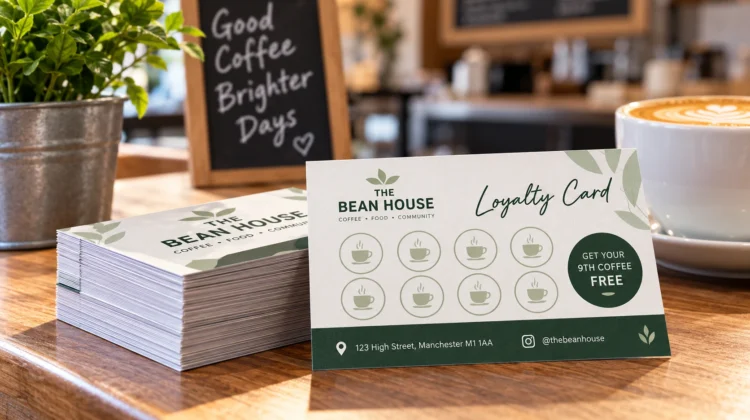
For example, a neighbourhood café might offer a free standard coffee after a customer purchases eight qualifying drinks. A beauty salon could reward regular clients with a discount on a future treatment.
The reward should suit the business, reflect what customers value and remain financially sustainable.
2. Keep Your Brand Visible
A printed loyalty card stays with the customer after they leave your premises. It may be kept in a wallet, purse or cardholder, serving as a reminder of your business.
Professional design can reinforce brand recognition through consistent colours, typography, a logo and a clear visual identity. Include your business name and essential contact details so customers can identify the card easily.
Unlike a promotion that disappears from a social media feed, a physical card can remain available for the customer to use on a future visit.
3. Build Stronger Customer Relationships
A loyalty programme can support customer relationships when it is combined with helpful service and genuine appreciation.
Staff can explain how the programme works, stamp the card accurately and acknowledge customers who are close to earning a reward. These small interactions can make the experience feel personal rather than purely promotional.
However, a loyalty card alone cannot guarantee customer retention. Product quality, convenience, pricing and customer service remain important factors in whether people return.
4. Support Word-of-Mouth Recommendations
Customers who enjoy a local business may recommend it to friends, family or colleagues. A well-designed loyalty card can reinforce the business’s identity and provide a natural opportunity to explain its rewards.
Businesses can also consider a separate referral offer, provided the conditions are clear and the incentive makes commercial sense.
Treat referrals as a potential benefit rather than an automatic result of introducing loyalty cards.
What Should a Loyalty Card Include?
A good loyalty card should communicate its offer quickly, without forcing customers to search for important details.
Include these essential elements:
- Business name and logo: Make the card recognisable.
- Reward details: Explain exactly what customers can earn.
- Stamp or progress spaces: Make progress easy to follow.
- Qualifying purchase rules: State what counts towards the reward.
- Redemption conditions: Explain when and how the reward can be claimed.
- Contact details: Add a website, phone number or other useful contact information when space allows.
- Readable design: Use suitable contrast, legible text and an organised layout.
Avoid overcrowding the card with long promotional messages or unnecessary design elements. The reward and the next step should be immediately clear.
Choose a Reward That Fits Your Business
The best reward depends on your average transaction value, profit margins and customer buying habits.
A café might offer a complimentary drink. A takeaway could provide a reward after a set number of qualifying orders. A salon might offer a modest discount on a future appointment.
Before launching the scheme, calculate the cost of the reward and consider how often customers are likely to redeem it. A generous offer that damages margins may be less useful than a smaller, sustainable incentive.
How to Create an Effective Printed Loyalty Card Programme
Step 1: Define One Clear Objective
Decide what you want the programme to achieve. You might want to increase repeat visits, encourage customers to try another product or strengthen relationships with existing customers.
Choose one main objective first. It will make the programme easier to design and evaluate.
Step 2: Keep the Rules Simple
Decide which purchases qualify, how many stamps are needed and what reward customers receive.
For example, a business might offer one stamp per qualifying purchase and a free selected item after eight stamps. This is an illustrative structure, not a recommendation for every business.
Explain any exclusions, minimum spend requirements, expiry dates or other restrictions before customers participate. Keep the wording readable and review the programme’s terms for fairness and transparency. UK guidance warns businesses against misleading commercial practices and unfair consumer terms.
Step 3: Design and Print Professionally
Choose a layout that reflects your brand and leaves enough room for stamps, handwriting or other tracking methods.
Check the spelling, reward wording, colours, logo quality and final dimensions before approving the print run. Consider a durable card stock that can withstand regular handling, while balancing quality against your budget.
Ordering a sensible initial quantity can help you test the programme before committing to a larger print run.
Step 4: Promote the Programme at the Right Moments
Introduce the loyalty card at checkout, when customers pay or when staff hand over an order. Display a small sign explaining the reward and make sure employees know how to answer common questions.
You can also mention the programme on your website, in appropriate social media posts and in customer communications. Keep the offer consistent across channels.
Step 5: Review and Improve
After launch, review how customers use the cards. If customers regularly forget to present them, consider a simple reminder at checkout. If few customers complete the programme, assess whether the reward, qualifying purchases or number of visits required is appropriate.
Make changes based on observed results rather than assumptions.
How to Measure Loyalty Card Marketing Results
Printed loyalty cards are most useful when businesses track a few straightforward measures.
Track these four indicators:
- Cards distributed: Count how many cards are handed to customers.
- Repeat visits: Compare customer return behaviour before and after the launch where reliable records are available.
- Redemption rate: Calculate redeemed rewards as a proportion of cards issued or eligible programmes completed, using a consistent definition.
- Reward cost and sales: Record the cost of rewards and compare relevant sales or contribution margins against the programme’s objectives.
For example, if a business issues 200 cards and 40 rewards are redeemed, the redemption rate is 20% when calculated against cards issued. This is an illustrative calculation; it does not establish that the campaign was profitable.
Where practical, use a simple spreadsheet to record distribution dates, stamps completed, rewards claimed and associated costs. Consider a small test before expanding the programme.
Why Printed Loyalty Cards Still Have a Place in Local Marketing
Digital marketing helps businesses reach potential customers, while printed loyalty cards can support the experience after a customer has already visited.
They can complement local search visibility, a well-maintained Google Business Profile, social media activity and in-store promotions. Each channel has a different role: online marketing helps customers discover a business, while a loyalty programme gives existing customers a reason to return.
Small businesses do not necessarily need a complex technology platform to begin. A simple printed card, clear rules, consistent staff processes and regular measurement can provide a manageable starting point.
Conclusion
Loyalty cards can support local business marketing by encouraging repeat visits, keeping a brand visible and making rewards easy to understand. Their effectiveness depends on choosing a suitable incentive, communicating the rules clearly and delivering a positive customer experience.
For UK small businesses considering loyalty card printing, start with a simple programme that fits your customers and profit margins. Track participation and redemptions, review the costs and refine the offer over time.
A well-planned printed loyalty card should do more than look attractive: it should give customers a clear reason to come back.
Frequently Asked Questions
1. What should a loyalty card include?
A loyalty card should include your business name or logo, a clear reward, spaces to record qualifying purchases and readable redemption conditions. Add useful contact details where space allows. Customers should understand how to earn the reward and claim it without needing a lengthy explanation from staff.
2. How can printed loyalty cards support repeat visits?
Printed loyalty cards give customers a visible record of their progress towards a reward. This can provide an incentive to return and choose the same business again. Results depend on the attractiveness of the offer, customer satisfaction and how easily customers can participate.
3. Are loyalty cards useful for small businesses?
They can be useful for businesses with repeat-purchase opportunities, including cafés, takeaways, salons and independent shops. A straightforward paper-based programme may be relatively easy to manage, but businesses should check the reward cost, likely customer participation and operational requirements before launching.
4. How many stamps should a loyalty card have?
There is no single ideal number. The right number depends on purchase frequency, average transaction value, reward cost and how quickly customers should be able to earn a benefit. Choose a realistic target that encourages repeat purchases without making the reward financially unsustainable.
5. How do you measure a loyalty card scheme?
Track cards distributed, completed cards, rewards redeemed, repeat visits and the cost of rewards. Compare results with a baseline or a similar period where possible. Use consistent definitions and avoid assuming that every redemption represents an additional sale.
6. Where can local businesses use loyalty cards?
Businesses can use them at tills, service desks, collection counters or appointment checkouts. Cafés, restaurants, salons, barbers and independent retailers may find them suitable when customers have a reason to return regularly. The programme should match the business’s buying cycle and customer experience.
7. Are printed loyalty cards better than digital loyalty schemes?
Neither option is automatically better. Printed cards are tangible and can be simple to distribute, while digital schemes may offer more convenient tracking and customer data capabilities. The right choice depends on your audience, budget, staff workflow and reporting needs. Some businesses may benefit from offering both.